Biostatistics & Microbiome Methods

Yiqian Zhang

Ph.D. Student in Biostatistics

Aspiring Biostatistician with a strong foundation in Mathematics and Statistics. Specializing in microbiome data analysis, compositional data transformation, and network dynamics. Experienced in developing novel statistical frameworks and computational models.

  • The Ohio State University
  • Microbiome Data Analysis
  • Compositional Data Methods
  • Statistical Computing
Portrait of Yiqian Zhang

Latest News

March 17, 2026

RAB Poster Award Winner at 2026 ENAR

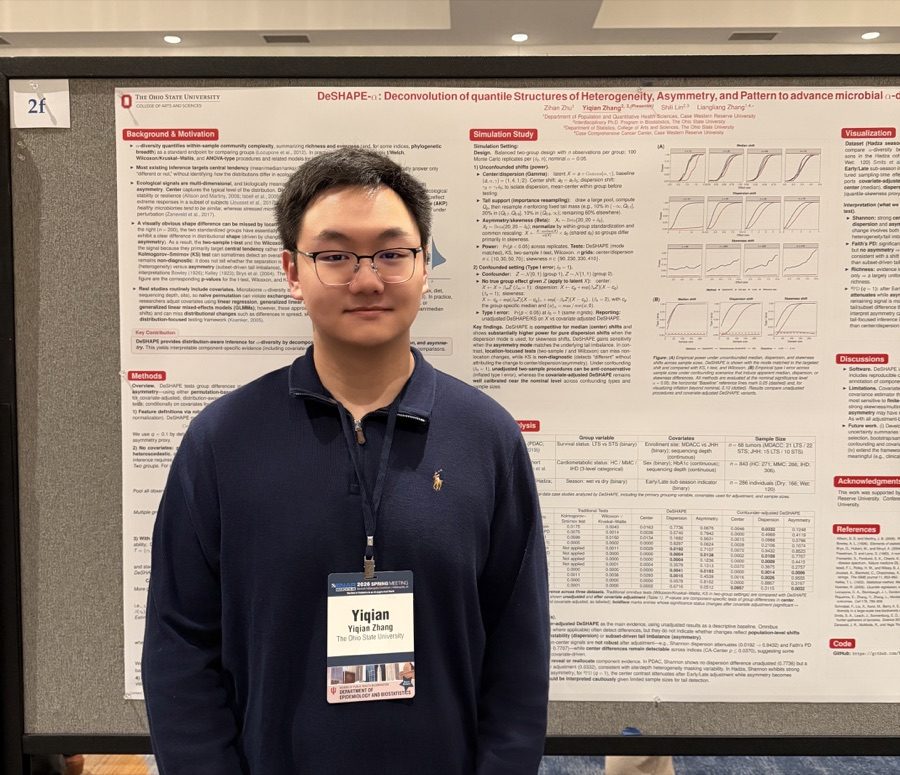
I am thrilled to announce that I am the RAB Poster Award Winner at the 2026 ENAR Spring Meeting for my poster titled "DeSHAPE-α: Deconvolution of Quantile Structures of Heterogeneity, Asymmetry, and Pattern to Advance Microbial α-Diversity Analysis".

Poster for DeSHAPE alpha microbial diversity analysis
March 15, 2026

ENAR 2026 Spring Meeting Presentation

I will be presenting my latest research at the ENAR 2026 Spring Meeting. Please stop by during the Sunday evening Opening Mixer and Poster Session on March 15. I welcome the opportunity to discuss my work and potential collaborations! Feel free to get in touch beforehand.

Educational Experience

The Ohio State University

Aug 2025 - May 2030

Ph.D. in Biostatistics

  • Honors & Awards: University Fellowship, ENGIE-Axium Incentive Recruitment Scholarship Award, Gary G. Koch and Family Graduate Student Travel Award.

University of Illinois Urbana-Champaign

Sep 2021 - May 2025

B.S. in Statistics and Double Major in Mathematics (Applied Mathematics Concentration)

GPA: 3.91/4.00

  • Honors & Awards: Highest Distinction in Statistics; High Distinction in Mathematics
  • Dean's List: Spring 2022, Spring 2023, Spring 2024, Fall 2024
  • Hoover Mathematical Scholar Award

Publications

Z. Zhu, Y. Zhang, S. Lin, and L. Zhang. "DeSHAPE: Decomposing Ecological Structure through Heterogeneity, Asymmetry and Pattern Evaluation of α-Diversity." Bioinformatics Advances.

2026 Under Revision

Z. Zhu, Y. Zhang, R. Liu, W. Li, Z. Huang, X. Chen, Y. Duan, and L. Zhang*. "Koinetic: A Graph-based Distance as a New Ecological Metric for Microbial Community Differential Analysis." Briefings in Bioinformatics.

2025 Under Revision

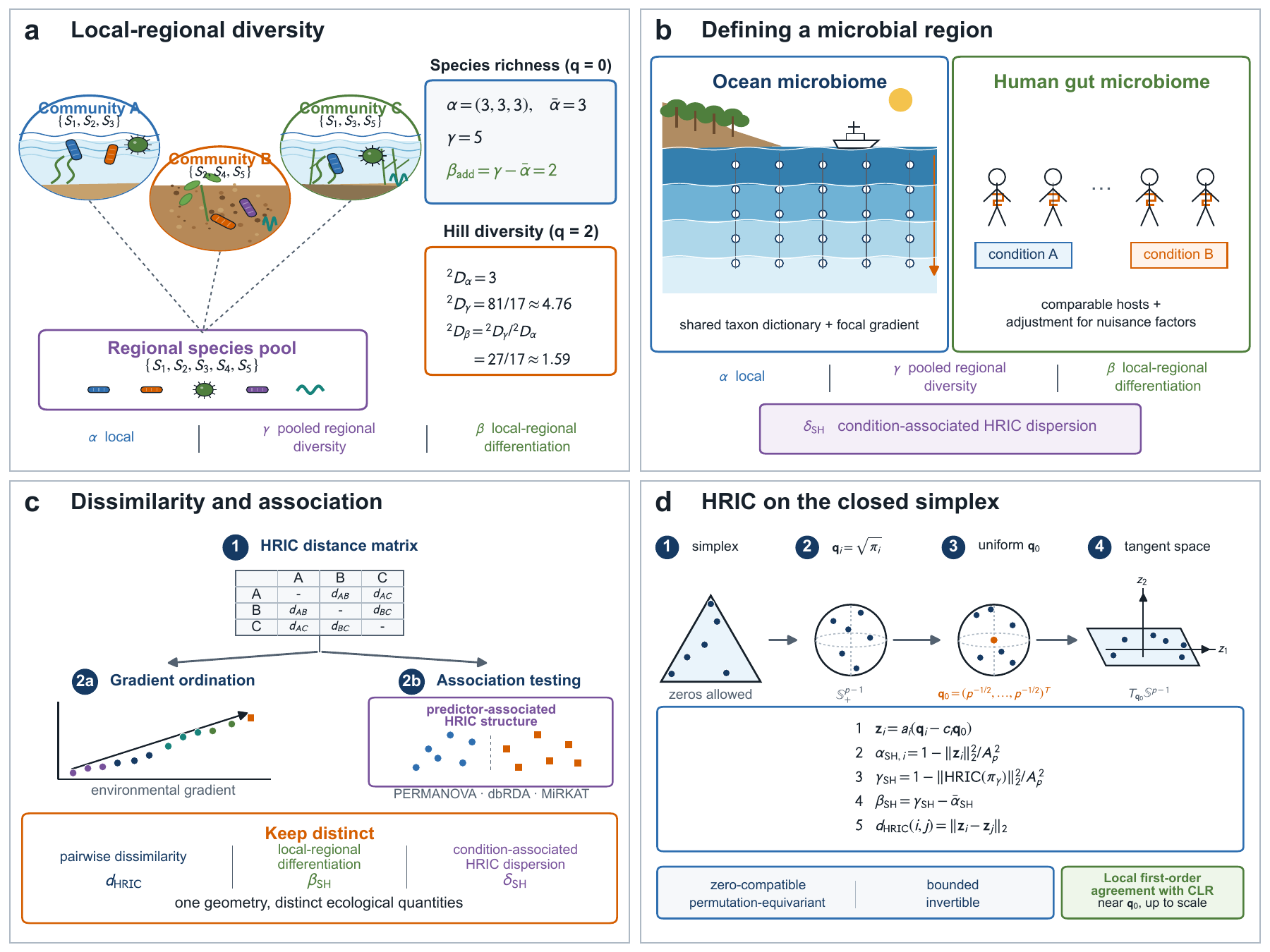
Z. Zhu, Y. Zhang, W. Li, M. Greenacre, S. Saha, Y. Shi, and L. Zhang. "Mathematical Foundations of Beta Diversity: Why Common Metrics Fail in Microbiome Analysis." Journal of Statistical Theory and Applications, vol. 25, article 9.

Abstract

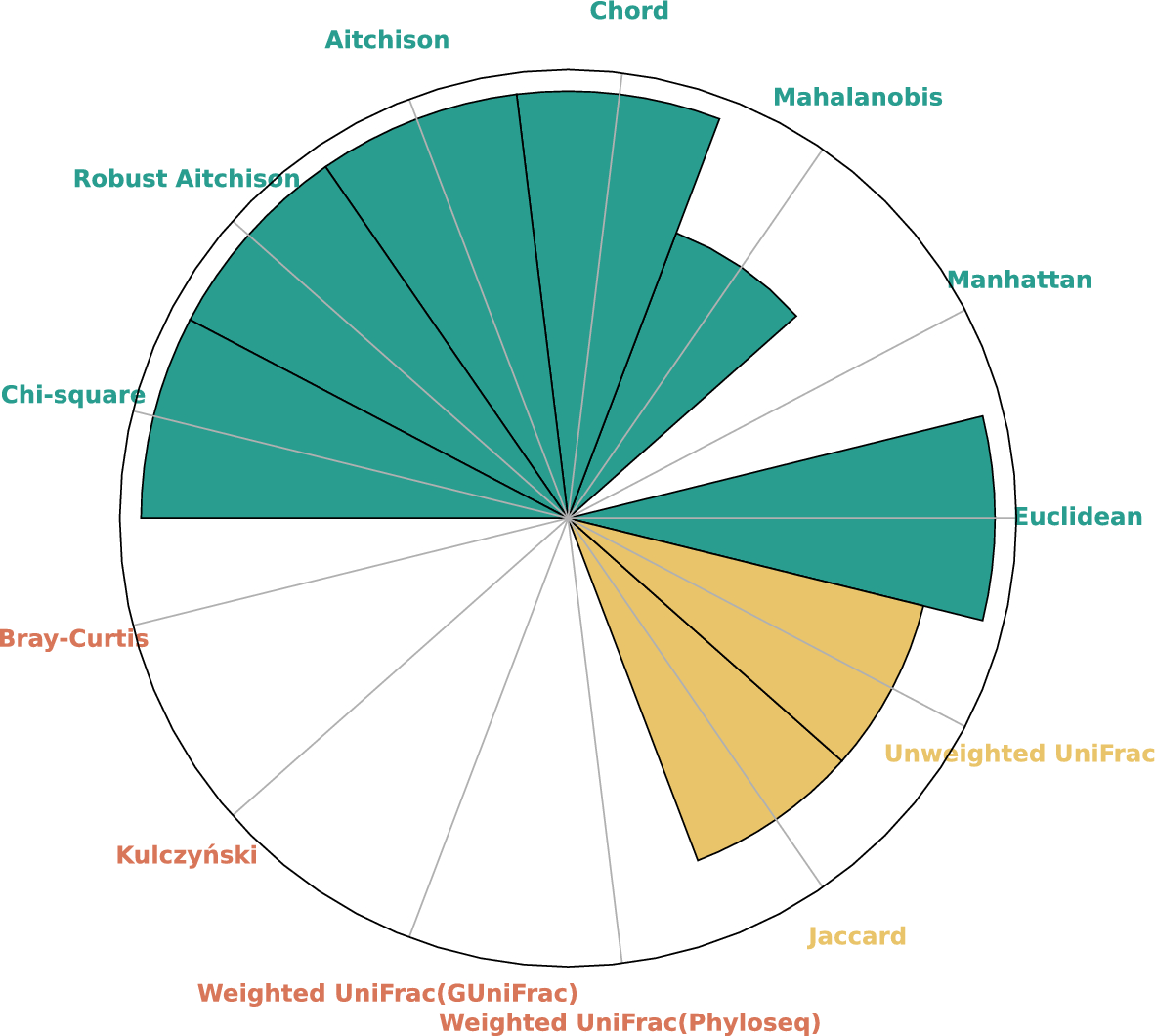
Beta-diversity analysis is central to comparing microbiome communities, yet widely used dissimilarity measures do not always satisfy the metric, Euclidean, or conditionally negative definite properties required by common downstream methods. We systematically evaluate popular measures, organize them into four mathematical classes, and show how property violations can distort PCoA, PERMANOVA, and kernel-based inference. We also introduce diagnostic tools and correction strategies that restore valid geometry while preserving ordination structure. Analyses across real microbiome datasets translate the theory into practical guidance, supported by an R package, interactive Shiny application, and reproducible tutorials for selecting and refining beta-diversity metrics.

Rose diagram comparing how often beta-diversity measures are both metric and Euclidean across six microbiome datasets
Figure 2. Frequency of metric and Euclidean behavior across datasets. Zhu et al. (2026), CC BY-NC-ND 4.0.

Y. Zhang, J. Schluter, L. Zhang, X. Cao, R. R. Jenq, H. Feng, J. Haines, and L. Zhang. "Review and Revamp of Compositional Data Transformation: A New Framework Combining Proportion Conversion and Contrast Transformation." Computational and Structural Biotechnology Journal, vol. 23, pp. 4088-4107.

Abstract

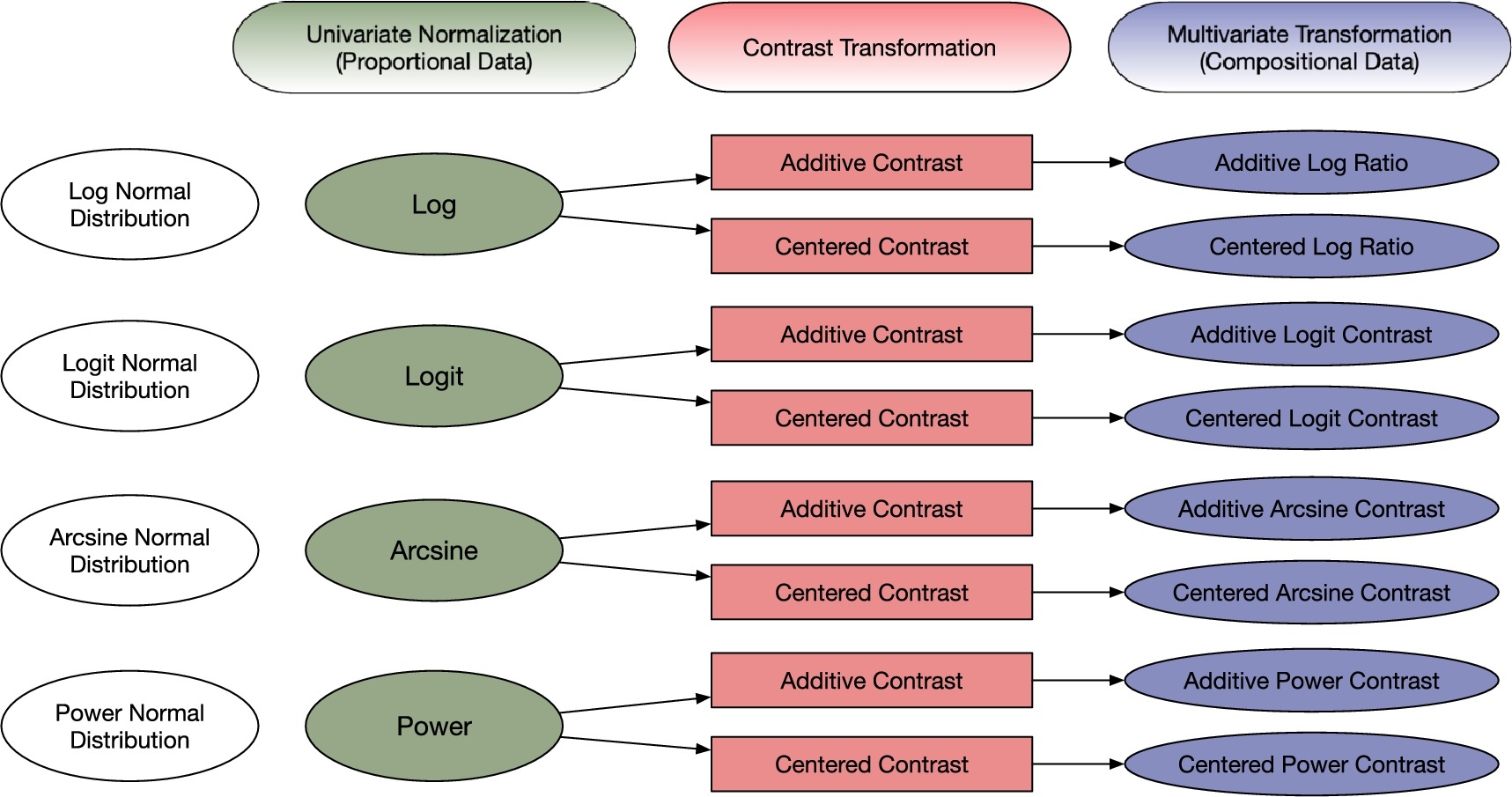
Microbiome abundance data combine unequal sequencing depth, compositional constraints, and frequent zeros, which can make standard scaling and transformation methods yield inconsistent conclusions. This work reviews the connections and distinctions among existing approaches and introduces a unified framework that pairs proportion conversion with contrast transformation. The framework recovers familiar methods such as ALR and CLR while enabling new transformations, including Centered Arcsine Contrast and Additive Arcsine Contrast. Simulation and data analyses indicate that the arcsine-based methods are particularly useful under heavy zero inflation, whereas log-ratio methods perform better when zeros are less prevalent, offering practical guidance for robust microbiome analysis.

Flow diagram combining log, logit, arcsine, and power conversions with additive or centered contrasts to produce compositional-data transformations
Figure 5. Framework for developing new compositional data transformations. Zhang et al. (2024), CC BY 4.0.

Teaching Experience

Introduction to SAS for Public Health Students (PUBHBIO 6270)

Teaching Assistant Aug 2026 - Present
OSU

Applied Bayesian Analysis (STAT 431)

Teaching Assistant Jan 2025 - May 2025
UIUC

Statistical Modeling I (STAT 425)

Teaching Assistant Aug 2024 - May 2025
UIUC

Statistics Programming Methods (STAT 385)

Teaching Assistant Aug 2024 - Dec 2024
UIUC

College Algebra (MATH 112)

Teaching Assistant Aug 2023 - May 2025
UIUC

Calculus & Calculus I (MATH 220 & 221)

Tutor Aug 2023 - Dec 2023
UIUC

Service

Treasurer

Aug 2025 - Aug 2026

Statistics & Biostatistics Graduate Student Association (BSGSA), OSU

  • Managed organization finances, reimbursements, and event budgets; served as banking liaison; coordinated student programming.

Peer Reviewer

2024 - 2025

Heliyon (Cell Press)

  • Completed 11 manuscript reviews in biostatistics/microbiome methods.

Proficiencies

Languages

English (Advanced) Mandarin Chinese (Native)

Technical Skills

PythonRSQLJavaC++SAS TableauDESeq2Kraken 2QIIME 2Git DockerMongoDBHPCLaTeX

Professional Competence

Machine LearningData MiningData VisualizationLinear Algebra CalculusProbabilityStatisticsWeb ScrapingGIS Database Management