Sparse compositional microbiome data

HRIC: Simplex Hellinger diversity for alpha, gamma, and beta structure

Hellinger-Riemann intrinsic coordinates represent microbiome compositions directly on the simplex, retaining boundary compositions while supporting diversity summaries and ordination.

Research structure

Three views of the same problem

The site is organized as a compact research narrative: the compositional geometry problem, the HRIC alpha-gamma-beta construction, and the classical diversity theory that motivates the partition.

01 Introduction

Geometry, zeros, and sequencing depth

Microbiome tables are constrained compositions. The introduction explains why zero handling and sequencing depth can distort CLR-based ordination, and why Simplex Hellinger geometry offers a stable coordinate system.
Read introduction

02 HRIC framework

Simplex Hellinger diversity partition

HRIC maps each sample into intrinsic coordinates. Alpha diversity is an evenness score, gamma summarizes the cohort center, and beta is the remaining among-sample turnover.

Read framework

03 Theory review

Whittaker alpha-beta-gamma diversity

Whittaker's alpha, beta, and gamma terminology separates local diversity, regional diversity, and compositional differentiation. The review clarifies how that ecological idea connects to HRIC.

Read review

Central idea

Diversity as geometry on the simplex

For a sample composition $\pi_i$ with $p$ taxa, HRIC gives intrinsic coordinates $Z_i = \mathrm{HRIC}(\pi_i)$. The same coordinate system supports within-sample evenness, cohort-level gamma diversity, and between-condition turnover without requiring artificial replacement of exact zeros.

$$\alpha_i = 1 - \frac{\|Z_i\|_2^2}{\left[\arcsin\sqrt{1-1/p}\right]^2}, \qquad \beta = \gamma - \frac{1}{n}\sum_{i=1}^{n}\alpha_i$$
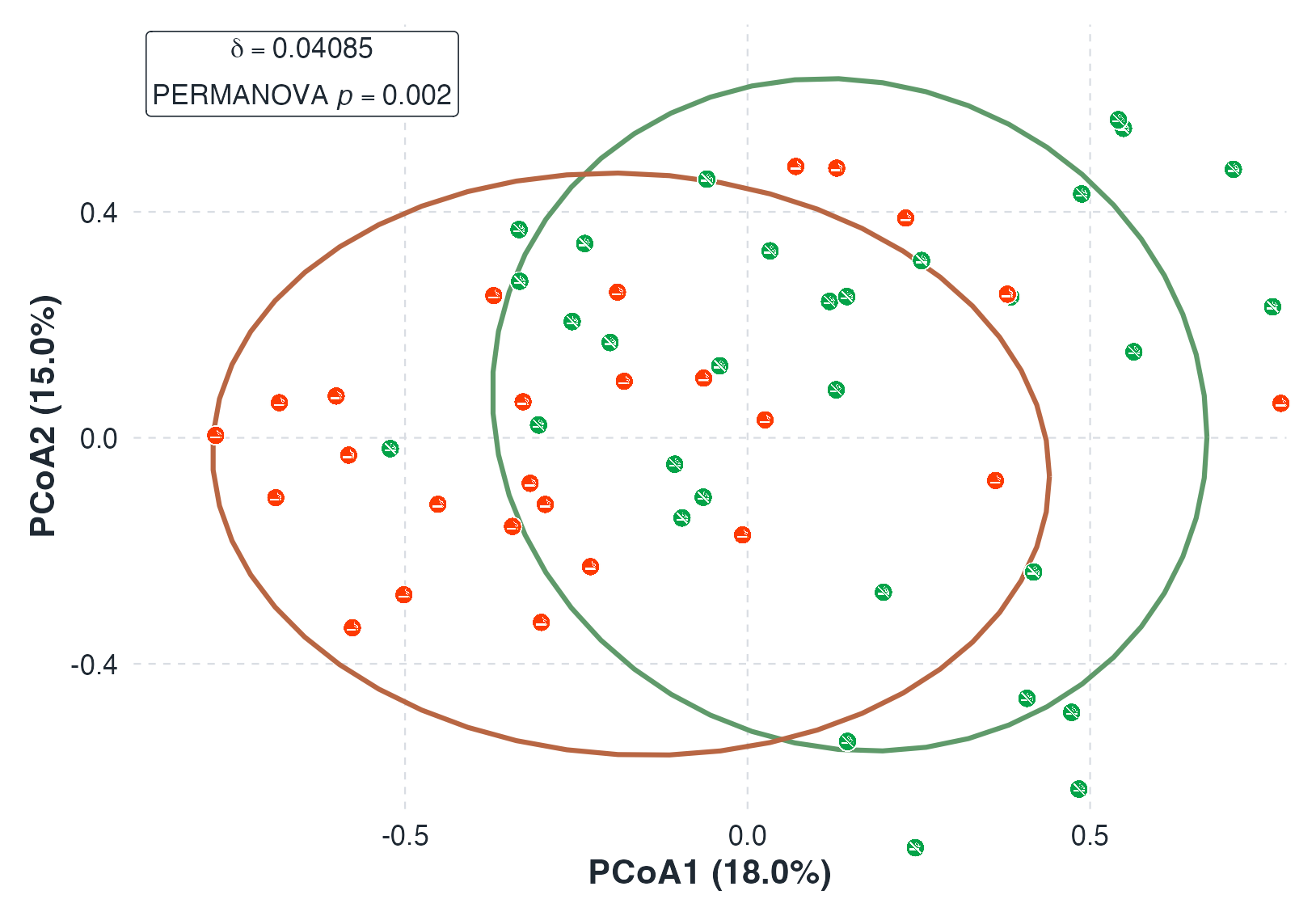
PCoA of Simplex Hellinger beta diversity by smoking status

HRIC coordinates support cohort-level beta structure, condition-relevant turnover, and formal group comparison in the same geometric system.

References

Foundational sources

The pages cite the ecological diversity literature, compositional data analysis, Hellinger transformations in community ecology, and the HRIC software implementation.

  1. Whittaker, R. H. (1960). Vegetation of the Siskiyou Mountains, Oregon and California. Ecological Monographs. doi:10.2307/1943563.
  2. Whittaker, R. H. (1972). Evolution and measurement of species diversity. Taxon. doi:10.2307/1218190.
  3. Aitchison, J. (1982). The statistical analysis of compositional data. Journal of the Royal Statistical Society: Series B. doi:10.1111/j.2517-6161.1982.tb01195.x.
  4. Legendre, P., & Gallagher, E. D. (2001). Ecologically meaningful transformations for ordination of species data. Oecologia. doi:10.1007/s004420100716.
  5. HRIC R package. github.com/yiqianomics/HRIC.